
How to prepare for a DCAA pre-award audit (and why it’s good for your business)
July 16, 2025
Government Shutdowns Aren’t New—But Your Small Business Can Be Ready
November 9, 2025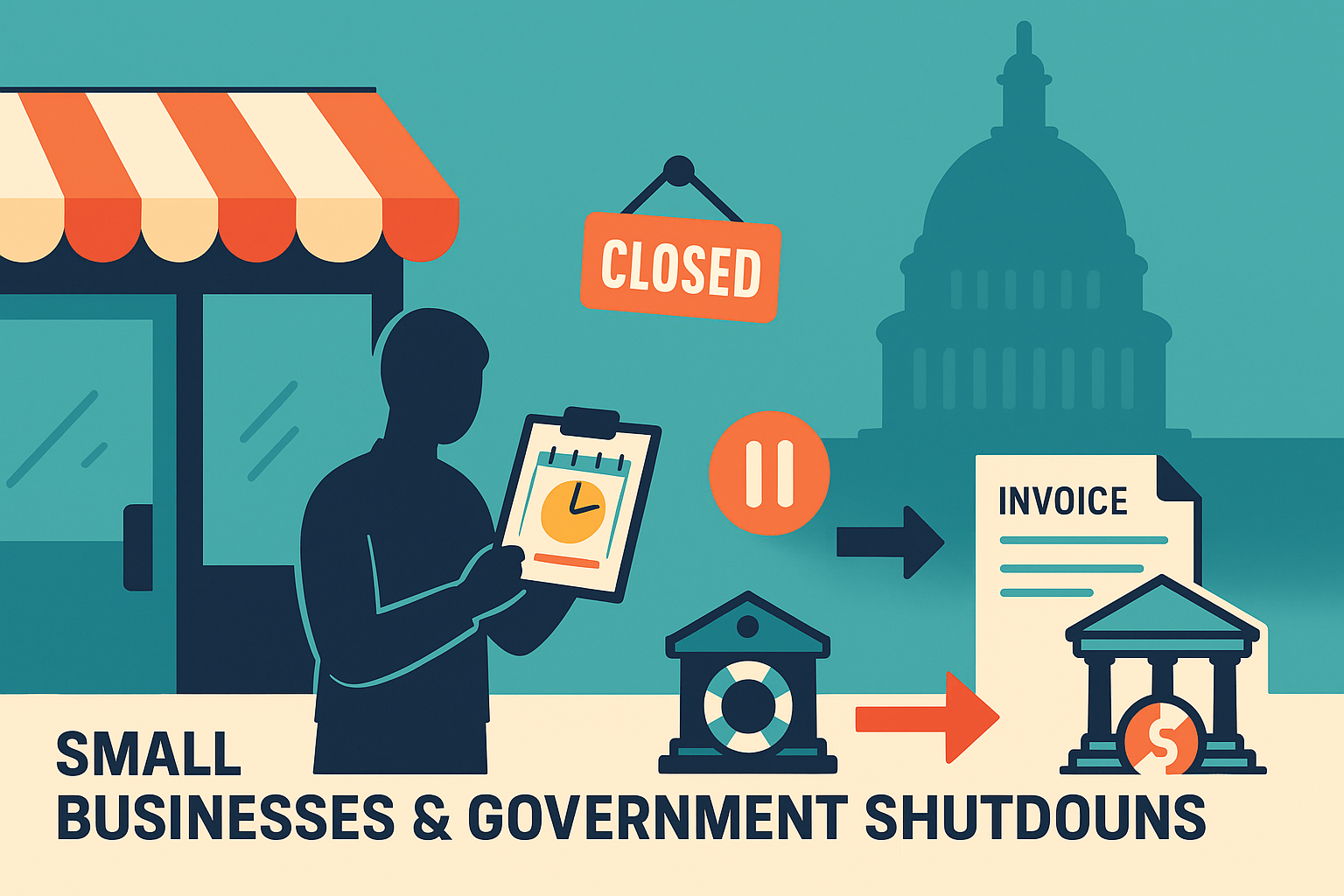
In a shutdown, the biggest risk isn’t unpaid work forever—it’s the cash crunch created when you can’t invoice past your funded ceiling. Track cash weekly, forecast run‑outs by task/CLIN, line up a LOC early, and communicate dates clearly to Primes and the Government.
Why funding dates (and communication) matter
- Working at risk drains cash. If you exceed the funding ceiling, you’re advancing labor and materials without the ability to bill now—even if you’ll likely recover later.
- Mods take time. Funding and direction can lag; payroll, rent, and subs do not.
- Alignment prevents surprises. Primes and Contracting Officers need early, accurate visibility so they can plan a mod, authorize a pause, or adjust scope.
This article shares operational practices, not legal advice. Review your contract’s funding and stop‑work clauses with counsel.
Three disciplines that protect your cash
- Know your current cash position.
- Maintain a rolling 13‑week cash forecast and update it weekly.
- Track burn rate against funded value, not total award.
- Set and enforce a stop‑work alert threshold (e.g., when forecasted funding runway < 30 days or <$X).
- Line up alternative liquidity (before you need it).
- Establish a line of credit (LOC) sized to at least one payroll cycle (ideally two).
- Keep modest covenant headroom and brief your banker quarterly so draws are frictionless.
- Make run‑out reviews a routine.
- Weekly: compare EAC vs. funded balance by task/CLIN; project a run‑out date and weeks of runway.
- 45–60 days ahead: notify your Prime/CO of the projected run‑out and assumptions.
- Document who owns the next action (mod, de‑scope, pause) and confirm interim direction.
Avoid AR factoring if at all possible. It’s fast but expensive, eroding margins when you most need them. Use only as a last resort after lower‑cost options (LOC, payment plans, accelerated approvals) are exhausted.
What to watch: KPIs & triggers
- Cash runway (weeks) = unrestricted cash / average weekly net outflow.
- Funded backlog ratio = funded backlog ÷ monthly burn (in months). Flag when < 1.5×.
- DSO (days sales outstanding): rising DSO during a shutdown is an early warning.
- Run‑out date by CLIN/task: update weekly; share trends, not just point estimates.
- Trigger events: hit threshold → freeze discretionary spend; <30 days runway → notify Prime/CO; <10 days → prepare stop‑work plan.
During a shutdown: a practical checklist
- Freeze non‑critical hiring, travel, and ODCs.
- Front‑load invoice prep so you bill same‑day when funding resumes.
- Hold a daily 15‑minute cash huddle (Treasury, Ops, PMO).
- Sequence vendor payments to protect critical path and payroll.
- Pre‑draft comms to Prime/CO; schedule cadence (e.g., every other Friday).
Example scenario (numbers you can adapt)
- Funded to date: $2.40M
- Costs to date: $1.86M → Remaining funded balance: $0.54M
- Average weekly burn: $120k → Runway: ~4.5 weeks
- Projected run‑out date: November 21, 2025
- Action: Notify Prime/CO at 6 weeks out; request $900k incremental funding or authorize a staffing ramp‑down. Hold LOC capacity equal to 2 payrolls (~$300k) to bridge if a mod lags.
Communication checklist (use every time)
- 📅 Estimated run‑out date and weeks of runway at current burn.
- 📈 Assumptions (staffing, subcontractor costs, material deliveries).
- 🔁 Cadence (e.g., updates every other Friday during the shutdown).
- 🧾 Ask explicitly: Is a funding mod planned? By when? What interim direction applies if funding lapses?
Templates you can copy/paste
1) Email to a Prime (you are the Sub)
Subject: Funding Run‑Out Projection for Subcontract [SubK ####] on Prime Contract [W91XXX‑##‑C‑####] — Action Requested
Hi [Prime PM/Contracts],
Based on current burn, we project reaching the funded ceiling for our [Task/CLIN] on [DATE] (≈ [X] weeks from today). Key details:
- Funded balance remaining: $[amount]
- Avg weekly burn: $[amount]
- Assumptions: [e.g., staffing plan, material deliveries, pending changes]
Request: Please advise on the plan to incrementally fund or provide interim direction (e.g., ramp‑down or pause) no later than [DATE] to avoid work at risk and cash‑flow disruption.
We will continue to monitor and will send updates [cadence, e.g., every other Friday] or sooner if assumptions change. A one‑page run‑out forecast is attached.
Thank you,
[Name]
[Title]
[Company] | [Phone] | [Email]
Attachments: Run‑Out Forecast (1‑pager), 13‑Week Cash Snapshot (optional)
2) Email to the Government (you are the Prime)
Subject: Funding Status & Run‑Out Projection — Contract [W91XXX‑##‑C‑####], CLIN [####] — Request for Incremental Funding / Direction
Dear [CO/COR Name],
We are writing to provide funding status and request direction for Contract [number], CLIN [####]. At the current rate, we estimate reaching the funded limit on [DATE] (≈ [X] weeks of runway). Summary:
- Funds remaining: $[amount] against funded value of $[amount]
- Average weekly burn: $[amount]
- Assumptions: [staffing, subcontractor commitments, deliveries]
Request: Please confirm whether additional funds will be obligated and the expected timeline. If additional funds will not be available before the run‑out date, please advise on interim direction (e.g., stop‑work, limited performance, or scope adjustments) to avoid working at risk.
We will continue to provide updates [cadence] and can meet to review the run‑out forecast at your convenience.
Respectfully,
[Name]
[Title]
[Company] | [Phone] | [Email]
Attachments: Run‑Out Forecast (1‑pager), Current Staffing/Deliverables Snapshot
Appendix: Quick run‑out math you can reuse
- Weeks of runway = remaining funded balance ÷ avg weekly burn.
- Run‑out date = today + weeks of runway (adjust for holidays/known ramps).
- Sensitivity: recalc at ±10% burn to set early‑warning thresholds.
Bottom line
Shutdowns magnify the cost of casual cash management. Small businesses that track cash tightly, secure flexible credit, and communicate funding run‑outs early minimize working‑at‑risk hours—and keep the lights on without sacrificing margin.